
AI Ops
Platform
An Autonomous AI Operations Platform that uses dynamic AI agent swarms to plan, develop, test, and document software solutions based on user tasks.
The Development Challenge
Traditional software development requires significant human effort for planning, coding, testing, and documentation. Organizations face:
Key Features
Comprehensive autonomous development capabilities
Dynamic Agent Swarm System
LLM analyzes task complexity and spawns 1-10 specialized agents based on requirements. Manager coordinates worker agents for parallel execution with result aggregation.
Intelligent Task Analysis
AI-powered task analyzer determines optimal agent swarm configuration. Chooses execution strategy (sequential/parallel/hybrid) based on task requirements.
Automated File Generation
Generates complete project structures including src/, tests/, docs/, templates/, and config/ directories with production-ready code.
Event-Driven Architecture
Publishes workflow events and tracks project lifecycle. Enables real-time monitoring and auditing of all agent activities.
Multi-Provider LLM Support
Configurable LLM integration supporting MiniMax, OpenAI, Azure OpenAI, and other providers for task analysis and decision making.
Project History & Versioning
Complete project history with version tracking. Stores all generated files with timestamps and agent attribution.
Execution Strategies
AI determines optimal approach based on task requirements
Sequential
Tasks executed one after another when there are dependencies between them
Parallel
Independent tasks executed simultaneously for maximum speed
Hybrid
Mix of sequential and parallel based on task dependencies and priorities
How It Works
8-step autonomous development workflow
Task Submission
User submits a task (e.g., 'Create a web app', 'Build an API', 'Write a script'). System accepts natural language descriptions.
Health Check
System validates availability of required services: LLM, Azure resources, and knowledge graph connectivity.
Task Analysis
Task Analyzer Agent determines optimal agent swarm (1-10 agents) based on complexity, dependencies, and required skills.
Agent Spawning
Manager Agent spawns worker agents based on task requirements. Each agent receives specific instructions and context.
Execution Strategy
AI decides execution approach: sequential (dependent tasks), parallel (independent tasks), or hybrid (mixed approach).
Parallel Execution
Agents execute tasks in parallel, generating code, tests, and documentation simultaneously for maximum efficiency.
File Storage
Generated files saved to structured directories: /projects/{project_id}/src/, tests/, docs/, templates/, config/
Report Generation
Final report generated with table of created files, execution summary, and recommendations for next steps.
AI Agent Types
Specialized agents working in coordinated swarms
Manager Agent
Orchestrates the entire workflow, coordinates worker agents, and aggregates results from parallel executions.
- Task decomposition
- Agent coordination
- Result aggregation
- Error handling
- Progress tracking
Task Analyzer Agent
Analyzes user tasks to determine complexity, required skills, and optimal execution strategy.
- Complexity scoring
- Skill mapping
- Strategy selection
- Resource estimation
- Risk assessment
Code Generator Agent
Generates production-ready code based on task requirements and architectural specifications.
- Code scaffolding
- Pattern application
- Best practices
- Documentation
- Type safety
Test Agent
Creates comprehensive test suites including unit tests, integration tests, and end-to-end tests.
- Test coverage
- Edge cases
- Mock generation
- Assertion writing
- Fixture setup
Documentation Agent
Generates README files, API documentation, and inline code comments.
- API docs
- Usage guides
- Architecture docs
- README generation
- Markdown rendering
Review Agent
Performs code reviews, identifies issues, and suggests improvements for generated code.
- Code quality
- Security scanning
- Best practices
- Performance hints
- Style checks
Technology Stack
Built with modern, scalable technologies
Flask
REST API backend serving endpoints for projects, workers, tasks, decisions, events, and alerts.
React 19 + Vite
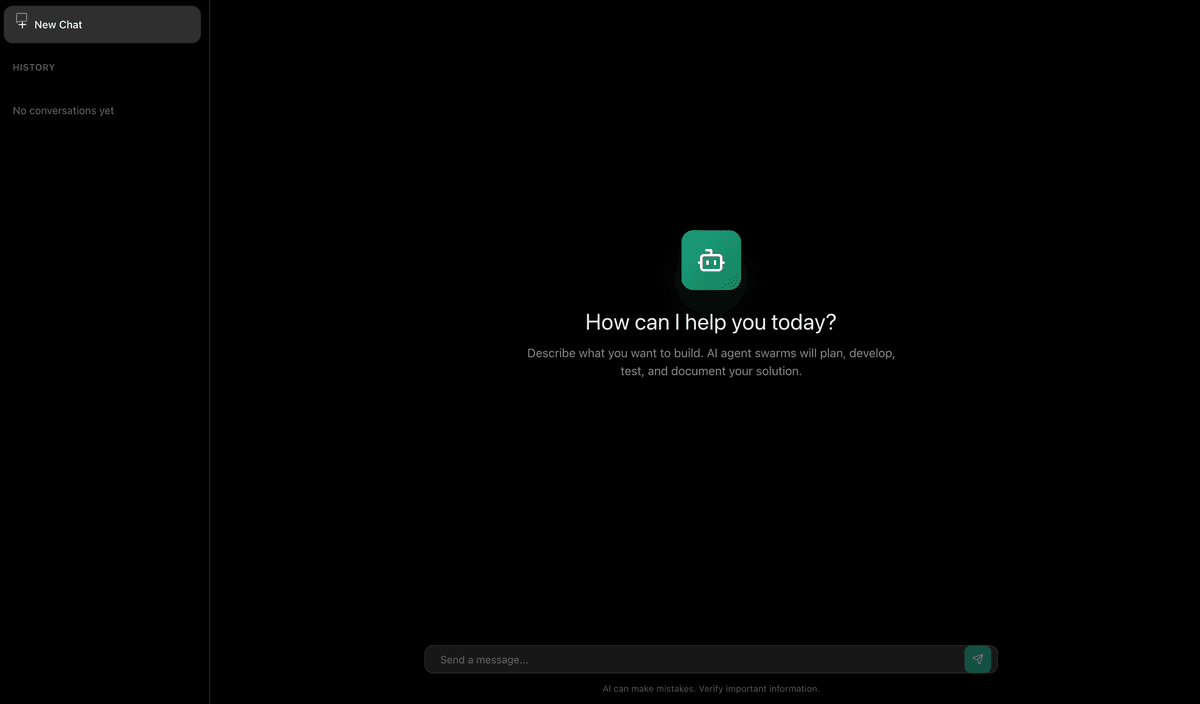
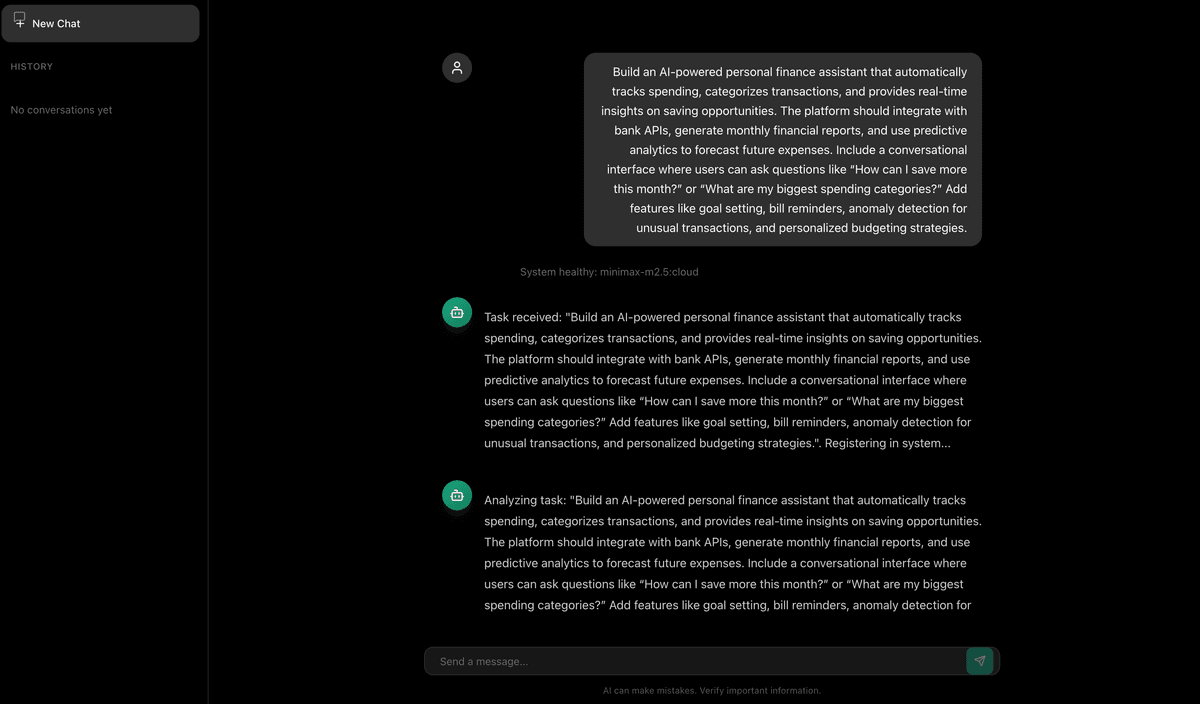
Modern frontend with ChatGPT-style dark UI, agent visualization, and markdown rendering.
SQLite Database
Local database (autonomous_ops.db) for project tracking, task management, and event logging.
MiniMax M2.5 Cloud
Primary LLM for task analysis, agent coordination, and decision making. Tested with Crafted framework.
Tab Agents
Browser-based AI agents for interactive task execution and real-time feedback.
Azure AI Foundry
Azure's unified platform for building, training, and deploying AI agents at scale.
Platform Preview
Interactive AI agent swarm visualization and task management
Azure Platform Integration
How AI Agents operate within the Azure ecosystem
Azure AI Foundry
The platform leverages Azure AI Foundry as the central hub for agent management, model deployment, and enterprise-scale operations.
- Unified agent lifecycle management
- Enterprise-grade security & compliance
- Auto-scaling based on workload
- Multi-region deployment support
- Integrated monitoring & diagnostics
Azure AI Agents
Specialized AI agents run on Azure infrastructure, leveraging enterprise capabilities for secure and reliable execution.
- Manager Agent coordinates workflow orchestration
- Task Analyzer Agent assesses complexity & strategy
- Code Generator Agent creates production code
- Test Agent builds comprehensive test suites
- Documentation Agent generates README & API docs
- Review Agent performs quality checks
Agent Execution Flow on Azure
Performance Metrics
Industry-leading autonomous development efficiency
Automation Rate
Of tasks completed without human intervention
Execution Time
Compared to manual development
Agent Coordination
Specialized agents per task
Code Quality
Pass rate on generated tests
File Generation
Structured project output
Cost Reduction
Reduction in development costs
Use Cases
Common autonomous development scenarios
Web Application Generation
Generate complete web apps with frontend, backend, and database integration from natural language descriptions
API Development
Create RESTful APIs with authentication, validation, and documentation automatically
Script Automation
Build automation scripts for data processing, file handling, and system administration
Test Suite Creation
Generate comprehensive test suites for existing codebases with high coverage
Documentation Generation
Auto-generate README files, API docs, and technical documentation
Microservices Architecture
Design and generate complete microservice ecosystems with service mesh
Data Pipeline Building
Create ETL pipelines for data ingestion, transformation, and loading
CI/CD Pipeline Setup
Build continuous integration and deployment workflows automatically
Transform Your Development
Deploy autonomous AI development for your organization. Get a custom demo tailored to your requirements.
Contact to Learn More